
Does saskatchewan really have a elk problem?
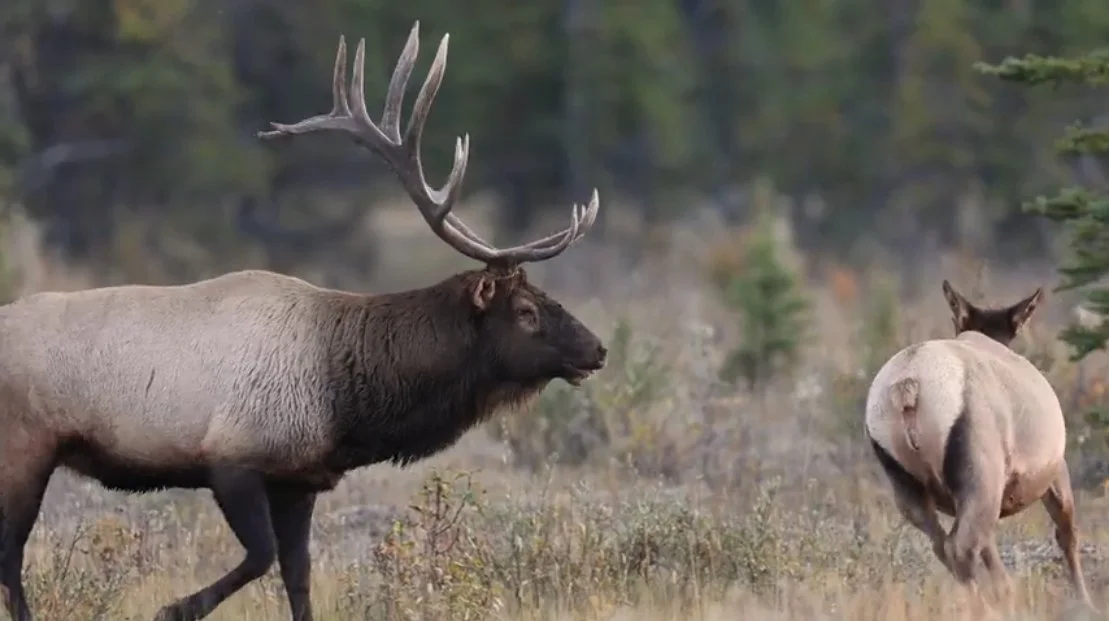
Policy, Not Population: Rethink Elk Management in Saskatchewan.
Does Saskatchewan have an elk problem? The simple answer is no. However, in order to debate and facilitate constructive conversation regarding a simple ‘no’ answer, a very detailed explanation is required. The caveat to an elk problem in Saskatchewan is that the numbers are high in some locations, low in some locations, and the problem regarding wildlife conservation and agriculture production in the province, is actually an elk management problem, not an elk population problem. And that is what Saskatchewan seems to be the proud owner of these days.
Spanning roughly 650,000 km2, but with a sparse human population of roughly 1.1 million, Saskatchewan overall has a resource problem as well. This resource problem is not elk, not moose, not deer, or fish, it’s a money problem. It’s simply a fact that there seems to not be enough funding generated in the province to effectively manage that other beautiful resource everyone shares - wildlife. And we all know that wildlife management needs money. Many parts flow into this equation and it all starts with the government. Insert eye roll here.
This cascading problem has many moving parts and they all seem to feed off of each other in somewhat of a trickle-down effect which encroaches on vicious cycle territory on some occasions. Premier Scott Moe signed a document that outlines methods, data, and steps for the wildlife resource in Saskatchewan, and this document is officially called “The Big Game Management Plan” (BGMP). It is a public document available online with a quick search that outlines management plans for a decade spanning 2018-2028. It details using science based data, reliable information, public and private consultation, and biologists working alongside everyone to manage wildlife populations in the province. In addition to the BGMP, there is a public document called the “Game Allocation Framework” (GAF) that reviews and dictates how hunting opportunities shall be shared among hunters, outfitters, and indigenous people. Its aim was for the equal and fair distribution of the wildlife resource to all those involved.
The problem is, the governing body of all of these plans, is the Saskatchewan Ministry of Environment (MOE). As outdoorsmen, this is our ministry, there are many like it, but this one is ours. However, this ministry is considered to be a small cabinet position in the province, and viewed in politics as a stepping stone to other more prominent positions. This creates somewhat of a revolving door of Ministers that the people look towards to lead the charge of responsible and informed conservation – but the concepts of revolving Ministers and long term planning ideas don’t play well together. That is evident as the province has had 6 ministers in the past 7 years, going back to Scott Moe himself in 2020. How does any group or population build a relationship of planning a future for our wildlife and conservation of habitat if no one is in the role for any length of time to actually have an understanding of what has happened, what is happening, and what needs to happen? The MOE knowledge base starts with the biologist team that works towards advising the government on the trends and status of what is going on in the province with various species of wildlife and conservation in general.
Hurdle number two is now trusting the biologists to have a firm and accurate grasp on their portfolios and then making recommendations using the data at hand. This can be a very tricky situation because when we circle back to the resource thing we call money, there is not enough of it go around. Biologists rely on various data sources to compile information and make informed decisions. These include hunter harvest surveys, which can be argued will be somewhat accurate to a +/- percentage that is scarier than it should be, to aerial surveys that get flown covering a management zone on average once a decade or two for a species, and then consultation with reliable formal organizations like the Saskatchewan Wildlife Federation (SWF), the Saskatchewan Bowhunters Association (SBA), Saskatchewan Commission of Professional Outfitters (SCPO), and the Saskatchewan Trappers Association (STA). That is a lot of data available to biologists to review, analyze, compile, and assess in order to build a picture of the provincial wildlife situation, and then transpose it over a vast area with multitudes of habitat types and environmental factors. No easy feat to say the least.
Boots on the ground should become a biologist’s best friend. Seeing as aerial surveys are very expensive, and rarely done, that data becomes only a snapshot in time of a population and does not really help with trending of a species through hard winters, drought summers, disease, and predation only to name a few factors. So the boots on the ground, as a blanket statement, are the organizations in this province that have tens of thousands of members all across the province actively participating in everything from hunting, to trapping, to angling, to eco-tourism and geocaching, and everything in between. These are the people that see it with their own eyes, and all of these organizations, although
they have their own needs held close to their hearts, and have the overall well-being of the resource first and foremost as the main goals of their groups. This is something to note of importance, the health of the resource for the use of future generations is the common denominator among all of the clubs, and brushing off their ideas and thoughts using an excuse of self-fulfillment, is a dire mistake in the past made by the Advisors as well as Ministry.
Consultation with these groups should be placed near the peak of the information mountain in order to build accurate and reliable plans for wildlife and its allocation. With the open season elk cull that occurred in the fall of 2025, and now the depredation tag system that seems to be on the agenda to implement in 2027, lack of consultation is glaringly evident. If the online backlash and attacks on the government from all sides of the public isn’t proof enough of that, the public denouncement of these actions by multiple organizations definitely is. The BGMP and GAF are documents that cite scientific data and consultation with knowledgeable groups as the key factors to responsible resource management. The two elk “solutions”, and I use the term loosely, that the government has put forward in the past 6 months absolutely ignore complete, well rounded, overall scientific data and meaningful consultation.
Moving on from the biology aspect, we need to encompass those affected by elk populations and congregation, which is the farmers and ranchers of the province. Land costs up, input costs up, efficiencies up, farmers and ranchers are looking at all available tools at their disposal to streamline their operations while maintaining growth, and profitability. What was once traditional to bring your entire bovine herd home and feed in corrals, has grown to everything imaginable including crop grazing, swath grazing, silage, mixed feed, pasture grazing, and traditional corral feeding over the winter months. With all of these methods, there needs to be a stash or stockpile of feed. This can be standing corn in fields all winter, to swaths cut, to bales and silage and feed given to the herd as needed but stored in a central location. All of these methods have pros and cons, with a common disadvantage being, wildlife can and will find ways to help themselves to these feed stores. And when wildlife eat standing crops, break open grain bags, knock down fences around bale stacks, insurance claims start rolling in for wildlife damage. This extends all the way into herds of wildlife setting up on pasture land that would be grazed by ranchers, or community pastures that get eaten down before cows can be let out to utilize both in winter and in rotational grazing etc. This concept and reality goes for waterfowl and big game both, not just our cute elk friends in the province.
The Saskatchewan Crop Insurance Corporation (SCIC) saw over 3000 individual claims from wildlife damage totaling $24 million in 2025. Down from 3000 claims totaling $30 million in 2024. Same amount of claims, significantly less damage. The end of year 2026 numbers are not available yet, but it will be interesting to see what the claims were after the autumn elk open season cull that took place. As a side note, for those that don’t know, nearly 12,000 open season elk tags were purchased as part of that announced hunt. Which brought in roughly $350,000 extra revenue to the coffers of the Ministry, with no statement yet on where those funds will be used. But nonetheless, crop damage claims were down from 2024 to 2025, but agricultural producers claimed that elk numbers and damage had been increasing and something had to be done. And guess what, the insurance claims are of course, a feeder into the provincial money issue. It always boils down to a money issue.
Precautions like bale yard fencing have programs in the province to be built by the producer, inspected by the agency, and then have reimbursement received by the producer. This covers initial costs but damages to an existing fence are not covered once constructed. Removing bales from fields can be tough with the weather in the province, but could be noted that it should maybe be mandatory in order to claim damage on those bales? Field and swath grazing opens a whole new can of worms because it is very efficient and cuts down on inputs and processing, but maybe some amount of damage should be expected and be considered acceptable? If you’ve have spent any time outdoors and spoken to anyone involved in the province, you will know that elk populations definitely need to be taken down in some areas, and in other areas, there has never been a huntable population, yet the government opened all of these areas to the open season hunt, with zero scientific data to justify it. Make it make sense.
The provincial government committed to utilizing the GMP which states that all available information at their disposal via advisors and meaningful consultation be used for any and all wildlife harvest allocations. That is in the document they signed and agreed to follow.
So if I say that elk in the province are not a population problem, but a wildlife management problem, what do we know about the situation? We know wildlife damage happens, whether its bales eaten that are either left in a field or stored behind fencing that bull elk damage, fields damaged and bushels being eaten by animals prior to harvest or intended grazing. We know that the population of elk are too high and exceed the carrying capacity of the natural habitat they reside in some areas, especially east central portions of the province. We know that there is not enough funding to accurately and reliably do physical herd counts of any species in the province with aerial surveys. We know that hunter harvest surveys really should be trusted fully. We know there is not enough money to put into programs to accurately give biologists proper data to avoid excessive guessing of populations. We know that millions of dollars are spent each year to reimburse producers for damages experienced. We know that with the last two elk hunt announcements little to absolutely no consultation occurred with the largest and most reliable source of data that exists, hunters and conservation organizations. We know that the province has a game management plan that has been thoroughly vetted and evaluated, and they agreed to follow in writing.
We know a lot. What we don’t know is why isn’t the Ministry of Environment consulting those users that have the information? Why aren’t they keeping someone in the Ministers office to properly build a knowledge base in a team there so that they stop embarrassing themselves in front of the public? And why aren’t they looking in the mirror and realizing that we don’t have an elk problem in Saskatchewan, we actually have an elk management problem?
Stu Christensen
