
TOO MANY ELK IN BC?
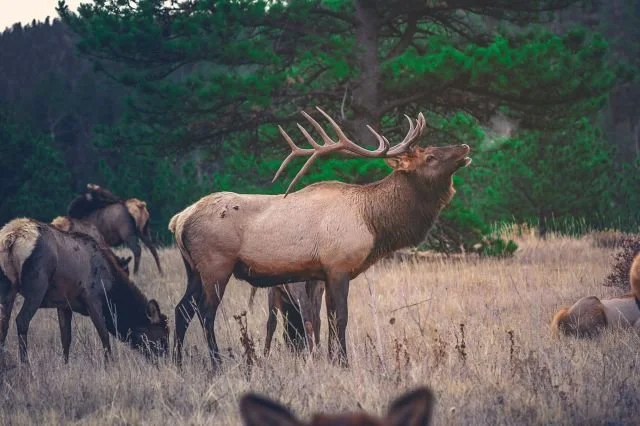
Too many elk in BC?
Rising elk populations causing problems for ranchers in BC.
Hunt Source has been closely tracking how elk are reshaping ranch and farm realities across British Columbia, and the story starts long before fresh tracks show up in a hay field. The discussion below is adapted, with permission, from the September/October 2025 issue of Beef in B.C., where it appeared as part of a broader look at elk in the province. We frame it through our lens at Hunt Source, where history, behaviour, and management intersect on working landscapes.
For many B.C. producers, elk are not easing back onto the land; they are arriving abruptly and in numbers that mean wrecked fences, hammered fields, and real financial losses. What feels like a sudden problem is actually the result of decades of ecological recovery, changing land use, and shifting wildlife behaviour colliding with long-established cattle operations and rural communities.
Historically, elk were widespread across B.C. Roosevelt elk occupied coastal areas and Vancouver Island, while Rocky Mountain elk ranged through the interior, moving seasonally between low-elevation winter ranges and higher summer forage in the presence of large carnivores. Around the turn of the 20th century, unregulated market hunting and habitat loss caused elk numbers to crash across much of western North America, just as livestock operations and rural settlements were expanding. Over time, many farm families came to see a landscape with few or no elk as normal.
In recent decades, that picture has flipped. Reintroductions, tighter hunting regulations, and declining predator numbers have driven a strong elk rebound in many parts of B.C. Translocations of Roosevelt elk from Vancouver Island to the Sunshine Coast in the late 1980s and 1990s successfully re-established mainland herds that later supplied further reintroductions. From a conservation standpoint, this is a success story; for landowners now experiencing intense elk pressure, it is also a major source of conflict.
Crucially, elk are returning to a very different landscape. Human settlement, roads, fences, and other infrastructure fragment habitat and block historic migration routes. Modern agriculture provides abundant, predictable, high-quality forage irrigated crops, standing and stored hay, gardens, and ornamental plants reducing the need for long-distance seasonal movements. Large carnivores usually avoid developed areas, creating “predator shields” that make fields and yards feel relatively safe to elk. Ranchers are increasingly dealing with herds that stay put year-round in agricultural zones, grow in number, and over-consume vegetation on private land.
At Hunt Source, we focus on behaviour because that is often where workable solutions start. Habituation and boldness are key. When elk repeatedly encounter people, machinery, and buildings without serious negative consequences, their fear response declines. Farms and residential areas are ideal settings for this process; once elk get used to moving through fields and yards unchallenged, they incorporate these spaces into their regular range, and these patterns are hard to reverse. On top of this, individual elk differ in temperament. Some are shy and risk-averse; others are naturally bolder and more exploratory. Over time, this leads to “personality sorting”: cautious elk tend to remain in wilder areas, while bolder elk increasingly concentrate in agricultural and urban zones and drive most human–elk conflicts.
These patterns are rooted in how elk perceive risk, often described as the “ecology of fear.” Predators shape prey not only through direct kills but through constant perceived danger that alters where and when prey move and feed. Yellowstone National Park illustrates this clearly: after wolves were removed, elk numbers rose and heavy browsing damaged plant communities. When wolves were reintroduced in 1995, elk numbers dropped and their behaviour changed. Elk began avoiding open meadows and riparian zones where wolves hunt more effectively, lightening browsing pressure and allowing vegetation to recover, which in turn benefited other species.
Human activity can act as a form of predation pressure, but elk adjust according to how predictable that pressure is. When hunting is confined to short seasons, daylight hours, or specific areas such as Crown land, while nearby private land remains relatively safe, elk learn to work around those patterns. They shift to more nocturnal behaviour and increasingly concentrate on private land where hunting pressure is lower. A study from east-central Alberta, near a fenced refuge closed to hunting, showed elk especially females with calves staying inside the refuge by day during hunting season, then moving onto adjacent farmland at night to feed before returning by sunrise. This kind of response mirrors what many B.C. landowners are now witnessing as elk move between safe zones and working lands.
Given this reality, we at Hunt Source have gone beyond documenting the issue to examine how other regions are managing it. Between January and April 2025, we carried out a jurisdictional scan of elk–agriculture conflict strategies in Alberta, the Yukon, Colorado, Idaho, and Montana, looking for tools that could be adapted in B.C. Our focus was on practical measures that help landowners and managers influence elk behaviour, reshape risk, and rebalance the relationship between growing elk populations and the agricultural operations that share their range.
From our vantage point, the “sudden” surge of elk on B.C. ranches is the visible endpoint of a long, complex process involving population recovery, transformed landscapes, predator dynamics, habituation, and individual animal personality. Any effective response in this province will need to build on that full picture, drawing on both local experience and lessons from other jurisdictions facing similar pressures.
HUNT SOURCE |