
PROBLEM ELK TO BE KILLED.
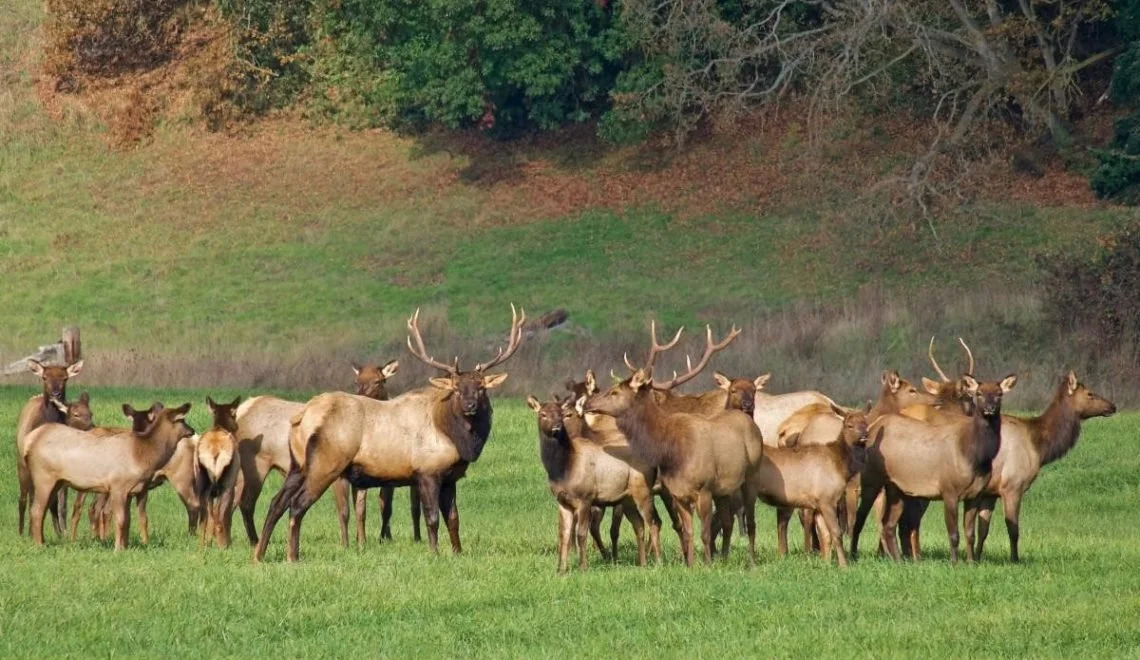
*Photo Credit: Michael DeMarco Sequim
In the spring and summer of 2026, Idaho Fish and Game plans to address chronic elk damage on private agricultural land west of Emmett by combining translocation with lethal removal of roughly 100 nonmigratory elk. Damages to crops in this area exceeded $1 million last year, prompting the proposed action.
The focus is on a resident herd of elk that stays year-round on private land belonging to five different landowners. Over the past five years this herd has grown to about 350 animals, even with consistent efforts by hunters, landowners, and Fish and Game staff to lower numbers and reduce conflicts. Despite the high level of damage, landowners ultimately received reimbursement for only about 35% of their reported losses. Two of the claims surpassed the state’s maximum single-claim depredation payment of $125,000, and total claims statewide last year outstripped the agency’s depredation fund, forcing all payments to be prorated under Idaho’s depredation laws.
To better understand the herd’s behavior, Fish and Game trapped elk from this group and fitted them with GPS collars. Location data show that these collared animals remain on private lands in Unit 32 throughout the year, with capture sites in summer and a dense pattern of locations through fall and early winter all falling within private property boundaries. This confirms that the conflicts are being caused by a resident, nonmigratory herd, not just by wintering migratory elk passing through the area.
Unit 32 lies within the Weiser Elk Zone, where elk numbers are currently above population objectives. The zone also supports large migratory herds, roughly 1,000 elk, that commonly winter on many of the same properties. To avoid affecting those migratory animals, the project is scheduled for spring and summer, when biologists can more reliably distinguish and target the year-round resident elk.
As part of the proposal, Fish and Game intends to trap and move approximately 40 elk from this resident group to one or more units that are currently below elk population objectives. The exact number will depend on how successful trapping efforts are. Trapped elk would be transported to public lands outside of Unit 32 where habitat is suitable for them. Experience from prior translocation projects has shown that trying to trap an entire large herd at once, or even a very high proportion of it, can create safety risks for the animals and is rarely effective. Elk also quickly become wary of traps, making it impractical to expect that all 100 targeted animals could be captured and moved.
To reach the overall objective of removing about 100 resident elk from these properties, Fish and Game proposes to work with the U.S. Department of Agriculture’s Wildlife Services to lethally remove the animals that cannot be trapped—likely around 60 elk. These elk will be sent to a licensed meat processor, and the processed meat will then be provided to regional food banks for distribution.
Although the private lands in question have effectively become “prime” elk habitat because of the abundant food, they are not being treated as a de facto refuge. Fish and Game has long offered general season hunts for both antlered and antlerless elk in Unit 32, and the cooperating landowners have allowed substantial, managed public hunting on their properties. In addition, Fish and Game has expanded opportunities through Landowner Permission Hunts to encourage more harvest on these lands. Even with those efforts, including the harvest of about 150 elk on these properties last year alone, high calf production driven by excellent nutrition has kept the resident herd from declining, and damage has continued.
Similar combined translocation and lethal removal efforts elsewhere in Idaho have successfully reduced problem elk herds and significantly lowered agricultural damage. Fish and Game has presented this proposed project to the Fish and Game Commission as a targeted, time-limited strategy to bring the local resident elk herd closer to management objectives while easing the financial strain on affected landowners.
| Hunt Source