
Hunt source field test | Ollin Snap Shot
Hunt Source Review
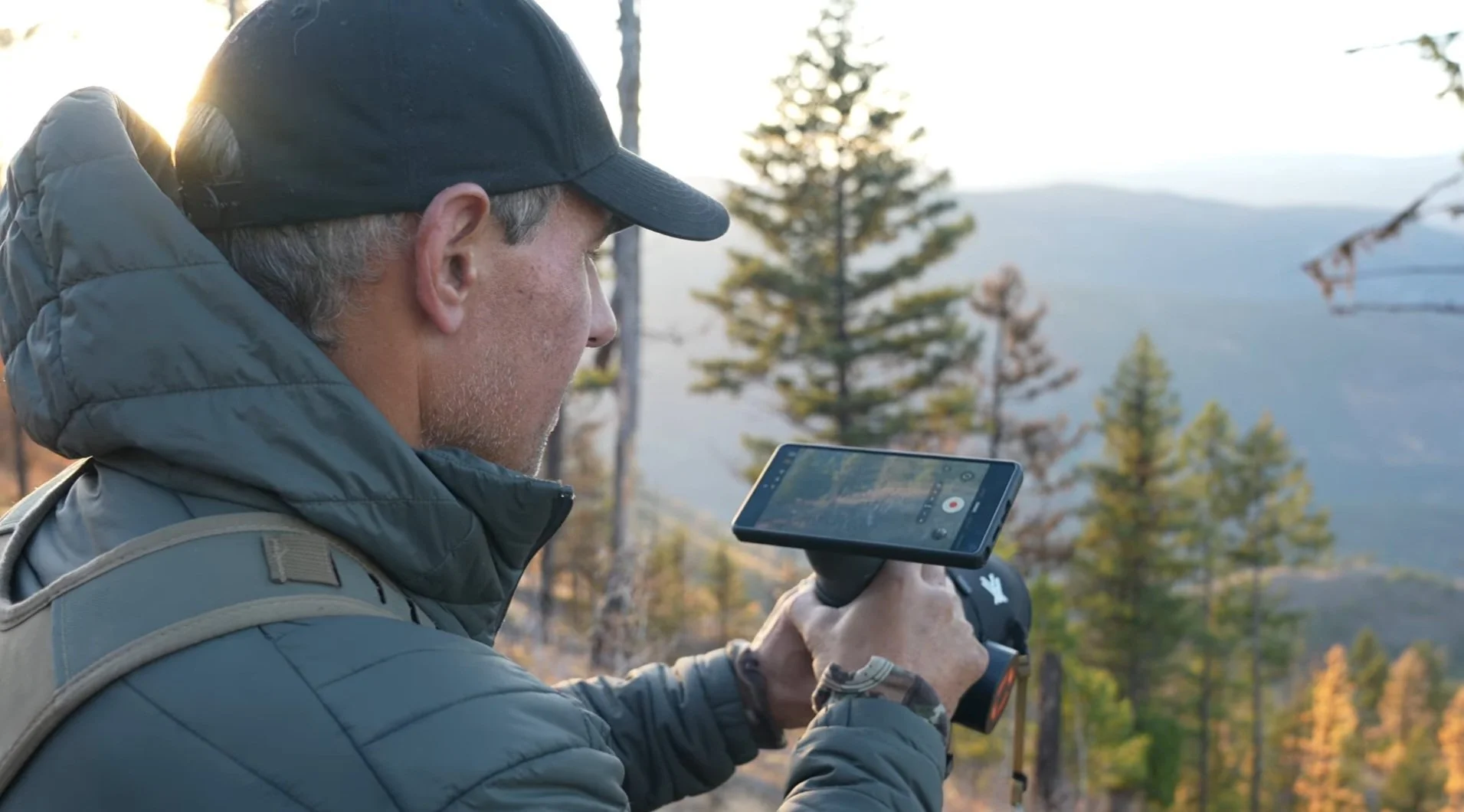
Before a northern BC mountain goat hunt, Kevin and Jake from Hunt Source decided it was time to clean up how they captured footage for their films without sinking thousands into a dedicated long‑range camera lens. They were after those classic mountain‑goat visuals: goats picking their way up near‑vertical shale, cliffed out on tiny ledges, or bedded on distant rock faces in country most people are lucky to hunt once in their lives. Those moments are the backbone of a great film.
After digging through options online, Kevin landed on the Olan Snapshot System, a digiscoping setup built to marry a hunter’s phone with their spotting scope. He ordered a kit, took it north into goat country, and put it through real field abuse.
What impressed him right away was how tailored the Olan Snapshot is to each user’s setup. When you order, you select your exact phone model and the spotting scope you run. Olan then builds the system around that combination so everything lines up properly. This isn’t a flimsy “universal” bracket you’re wrestling on a windy ridge; it’s purpose‑built for the gear already riding in your pack.
That custom fit does come with a trade‑off. Every time you upgrade your phone, you’ll need a new Olan case. For Kevin, that was an acceptable compromise because the case itself is genuinely well built. Running a Samsung S25 Ultra, he found the case fit tight, with all the buttons lining up exactly where they should. A built‑in magnet sits directly over one of the phone’s camera lenses and acts as the anchor point, allowing the phone to snap onto and off the eyecup quickly and consistently.
Like most digiscoping systems, the Olan setup has one inherent limitation: it uses only a single camera lens on your phone. Kevin’s S25 carries five lenses, but once the phone is locked into the Olan system, only one is active. The ultra‑wide and some of the phone’s built‑in zoom options are effectively sidelined. In practical terms, that forces a change in how you handle zoom. With the phone clipped to the scope, any attempt to pinch‑zoom on the screen causes the image to go black as the phone tries to switch to a different lens that’s no longer aligned.
Kevin and Jake worked around that almost immediately by stopping all digital zoom on the phone. Instead, every bit of zoom came from the spotting scope. That approach not only avoids the lens‑switching issue, it also produces better footage. Optical zoom through quality glass will beat digital zoom on a phone every time, especially at distance. Once they accepted that the phone’s job was simply to record what the spotting scope was already seeing, the system felt natural and intuitive.
There was still a minor learning curve when switching between glassing with the naked eye and filming through the phone. The focus setting that looks perfect to the human eye is not always the same point a phone camera prefers. Kevin’s solution was simple and repeatable: crank the scope’s zoom one way, clip the phone on, then slowly adjust the focus until the image on the screen snaps into clarity. In doing that, he was essentially teaching his fingers a slightly different “stop point” on the focus knob whenever the phone was involved. After a few repetitions, that adjustment became automatic.
The Olan Snapshot System is built around two main components: a dedicated phone case and an eyecup cut for a specific spotting scope. The case is slim and durable without feeling bulky. Kevin added a screen protector and carried the phone in his bino harness for most of the trip, without worrying about it getting scratched or hammered by other gear. When it wasn’t in the harness, it slipped easily into a pant or jacket pocket, so it never felt like extra baggage while climbing, side‑hilling or crawling through rocks.
The eyecup is where the system really comes together. It is machined to match a particular spotting scope model. You set up the scope as usual, then slide the Olan eyecup onto the eyepiece and align the small red Olan symbol printed on it. That red mark needs to point straight down. It’s a small detail that matters: when the phone attaches to the magnet in the case, a correctly oriented eyecup keeps the image level whether you’re filming in portrait or landscape.
Kevin tested this orientation himself. By intentionally installing the eyecup with the red dot at about the four o’clock position, he watched the horizon tilt noticeably the moment he clipped his phone on. The footage looked off‑kilter and crooked. With the red mark centered straight down, the phone locked on square every time and the image stayed level.
Once the eyecup is oriented correctly, you seat the scope’s eyepiece fully and push the Olan eyecup on until it fits snug. That solid, wobble‑free connection is important at higher magnifications, where even small shakes show up on video. Olan also includes a magnetic protective cover for the eyecup. It snaps on and off easily, keeps dust and grit off the glass, and is tethered to an adjustable strap to reduce the risk of losing it in grass, snow or brush.
An additional accessory, the Olan Snapshot Tool, extends the system even further. It’s a band with a magnet that wraps around the spotting scope, giving the lens cover a solid place to park when it’s not in use. On a recent moose hunt, Kevin found himself setting up the scope in the wind while the lens cover repeatedly swung down and tapped against the tripod. The noise wasn’t loud, but it was irritating and far from ideal in a hunting situation where subtle, repetitive sounds can matter. A dedicated magnetic anchor to hold the cover out of the way would solve that issue entirely—a small refinement that only becomes obvious after you’ve spent real time behind the glass.
Taken as a complete package, the Olan Snapshot System is straightforward and consistent. Once it’s installed and aligned, every time the phone is clipped to the eyecup it lands exactly where it should. There’s no hunting for the right position or fighting to center the image. The setup runs smoothly in both portrait and landscape modes without constant adjustment. The eyecup itself helps block stray light from the sides, producing clearer footage with better contrast, especially in bright sun or snow‑covered terrain.
The video quality the system produces is impressive. Modern smartphones have evolved into serious imaging tools and, when paired with a good spotting scope, they can generate long‑range footage that comes surprisingly close to what some high‑end camera lenses deliver. The Olan system is not meant to replace a full production camera rig, and for most hunters it doesn’t need to. For anyone who wants to document hunts, film animals at a distance, review footage later or share clips with friends and the broader hunting community, the Snapshot System makes it hard to justify the cost and bulk of a dedicated long‑range lens. It simply links two tools most hunters already own: a phone and a spotting scope.
From a cost perspective, the Olan Snapshot System is fairly priced for what it offers. It’s available in both Canada and the United States, and Kevin shares a promo code through his original Hunt Source review for those looking to save a bit. It’s not a bargain‑bin impulse buy, but compared to building out a full camera system with specialized glass, it’s far more approachable.
Most importantly, this system hasn’t lived its life on a shelf. It has been carried into northern BC goat country, hauled on moose hunts closer to home and bounced around in real conditions. It has been dusted, wind‑blown and pulled in and out of a bino harness more times than Kevin can count. Through that use, it has held up, stayed compact and unobtrusive, and consistently done what it’s designed to do: capture solid long‑range footage without complicating a hunter’s kit.
Based on that time in the field, Hunt Source is comfortable standing behind the Olan Snapshot System. For hunters who spend serious hours behind a spotting scope and want a simple, reliable way to bring those far‑off moments home, this digi-scoping setup has earned its place in the pack.
**See Full Review Video https://youtu.be/UQfNS3VlZaA
Hunt Source
Written assist with ai