Early Opportunity: A Saskatchewan Velvet Double
By: Landen Fidek | Hunt Source
At the beginning of the 2025 season, a small line in the regulations book quietly changed the course of my September. The extension of the open archery elk season gave me something I hadn’t had in years… breathing room.
For as long as I can remember, elk owned the first half of my fall. Short seasons demand commitment, and commitment demands sacrifice. Mule deer always came after. But mule deer in early September, when they’re still in velvet and grouped up in bachelor groups, are different animals entirely. Predictable. Patternable. Vulnerable, if you’re disciplined.
When you find one buck, you usually find several. And if you’re patient enough to watch, they’ll tell you exactly how to kill them.
This year, I finally had the time to listen.
The landowners who allow us access to some of the best ground in the area had been keeping us updated all summer. Trail sightings. Field observations. The kind of information that builds anticipation long before opening day. We normally like to scout hard three or four days ahead of season, glassing at first and last light, watching where bucks feed and where they disappear when the sun climbs.
But life compresses plans sometimes. A couple of highly sought-after draw tags shifted our focus. Instead of days of scouting, we rolled in on opening day with confidence in the land and gratitude for the people who make it accessible.
Coffee around the kitchen table with landowners that have become great friends that morning meant as much as anything that followed. Permission built on trust is something I never take lightly.
By early afternoon, the prairie heat had settled in. The kind of dry warmth that carries the smell of sage and dust. We eased into familiar country, glassing from the truck, picking apart coulees and long ridgelines that fold into one another like waves.
My hunting partner, and I hadn’t gone far when we spotted a solid typical 4x4 trailing two other bucks. Clean frame. Good spread. Heavy velvet hanging thick and dark. We parked well out of sight and slipped down a roadside ditch, crawling just enough to set up the spotting scope without being silhouetted.
For twenty minutes we watched them feed, chewing slowly, relaxed. Waiting. Hoping they’d bed somewhere killable.
Eventually, they dropped into a sage-filled draw. Not perfect. But workable.
We looped wide, nearly half a mile, to approach with what little wind we had. That’s when the afternoon nearly unraveled. A smaller fork-horn appeared. As we worked the sidehill toward him, we bumped two more deer, one of them a very respectable buck. They bounded off, stopped, and fed again.
Just close enough to tempt fate.
My partner decided to make a move. He slid through tall grass and buckbrush that hadn’t been grazed down, using every fold in the terrain. I hung back with the camera, heart thumping almost as hard as if I were the one behind the bow.
I watched him range. Adjust his sight. Set his feet.
When the shot broke, I knew before the arrow landed. Clean miss! Just over the buck’s back.
The deer crested the hill and disappeared.
There’s a strange mix of disappointment and relief in a clean miss. No wounded animal. No long night. Just a reset.
And we still had our original three bucks bedded.
The wind gave us no creative options. The only play was aggressive, crest the ridge above them, identify the right buck, and come to full draw fully exposed against the skyline.
Forty-five yards.
We eased up, peeking just enough to confirm position. All three bucks stood at once, staring, trying to make sense of the shape that had appeared where the sky should have been empty.
The arrow left the string.
You know a good hit by the sound… a heavy, muted thump that carries finality.
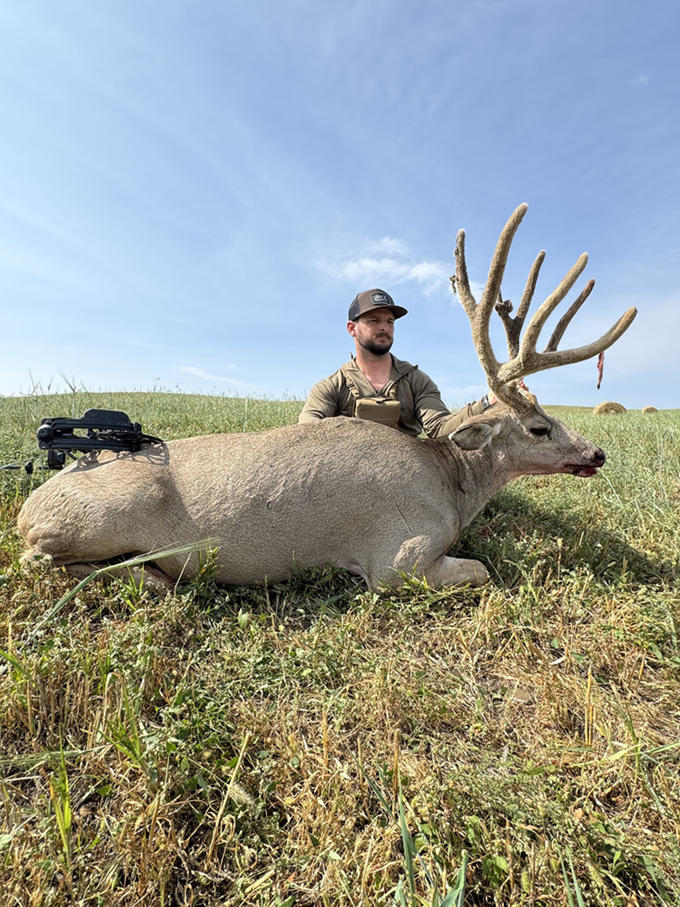
The two smaller bucks bounded away. The larger buck ran hard toward the direction of the truck, tail tucked, covering ground fast before suddenly collapsing within 180 yards of where he was hit.
My partner stood on the opposite ridge, hands raised in the air.
His first full velvet buck.
A beautiful, symmetrical Saskatchewan mule deer, tall tines, clean frame, thick body still heavy from summer feed. By 4:30 p.m., he was quartered and in the cooler, the meat already beginning to chill.
Most hunts would end there.
But September light lingers, and so did we.
That evening scout showed us exactly what we hoped to see, more bucks feeding in predictable locations. After a meal filled with replayed moments and quiet gratitude, we went to bed knowing the next morning held real potential.
At first light, less than two miles from the farm, we found him.
The buck.
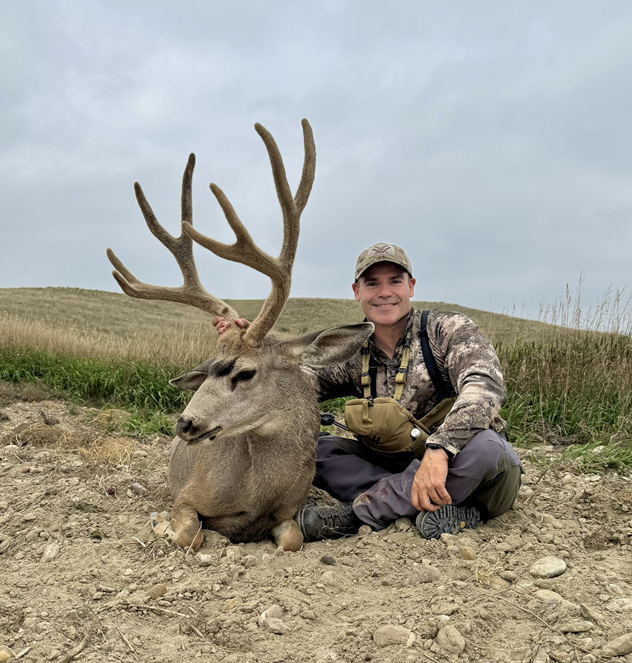
Widespread mainframe 4x4. Deep forks front and back. Velvet thick and flawless. He moved with two other bucks, already drifting more than a mile toward bedding.
We knew the country. The coulees. The small tree patches. The shaded north faces. OnX confirmed what instinct already told us, we had a strong guess where he was headed.
The wind direction was technically right.
But it was almost nonexistent.
Still air in dry country is unforgiving. Every stalk becomes surgery.
We covered ground slowly, glassing every fold in the terrain. Eventually, tucked into a small drainage with willows and taller trees, we found them bedded — four bucks, including our target.
We looped north, dropped into a dry riverbed with knee-high grass, and closed the distance. That’s when I looked up and locked eyes with a whitetail doe standing less than 20 yards away.
She wasn’t alarmed, just aware. And then she walked straight toward the bedded mule deer.
I felt helpless watching her angle directly at them. She nearly stepped on our target buck before the mule deer rose and shifted to the opposite side of the willows.
For a moment, I thought it was over.
Instead, they re-bedded in an even better position.
We circled south, crossed an oat stubble field that sounded like breaking glass under our boots, and dropped our packs at 250 yards. From there, it became painfully slow.
Every step placed with intention. Cactus underfoot. Dry stems waiting to betray us. I loosened the BOA system on my boots to let them flex and move quieter, choosing protection over silence as cactus thorns poked through thin soil.
At 120 yards, willow tops appeared.
At 80 yards, I saw velvet antler tips.
Then I dropped to my hands and knees.
With almost no wind, movement had to be microscopic. Six inches at a time. I could feel my heartbeat in my ears. Sweat gathered and rolled down my nose as I crawled. Dirt filled my palms. Sage brushed against my sleeves.
Eventually, I reached a small bluff roughly 50 yards from his bed. I eased up just enough to see his head, ears flicking lazily at flies.
I settled onto my knees and waited.
The sun pressed down. Time slowed. My legs began to ache.
Then one of the smaller bucks stood.
I came to full draw.
Seconds later, my target buck rose, facing me directly. Calm. Curious. Unaware of the exact danger in front of him.
The pin settled.
I released.
He dipped slightly. The arrow struck a touch higher than I’d hoped, but solid. The bucks exploded in different directions.
We crested the ridge, scanning desperately. No obvious blood at first. The doubt creeps in quickly in those moments.
Then my partner froze behind his binoculars.
“He’s right there, buddy.”
At 150 yards, I saw the white of his belly.
The relief is physical. A weight lifted from your chest. Walking up to him, I remember saying, “Man, does it feel good to win!”
His velvet, perfect before the shot, had torn slightly in the fall. The drop in blood pressure must have been immediate. He never slowed, just ran until his legs were gone beneath him.
He was an incredible mainframe deer. Heavy-bodied. Mature. The kind of buck that represents years of patience and opportunity.
After photos and processing, I called the landowner. Sharing the story, seeing the pride in their faces, celebrating together, that’s part of this life too.
Two Saskatchewan mule deer archery tags filled in short order.
But what stays with me isn’t just the antlers.
It’s the coffee at sunrise.
The sting of cactus.
The silence of dead wind.
The humility of a miss.
The redemption of the next opportunity.
The friendships built on shared ground.
Early September mule deer, velvet, bachelor groups, long crawls across dry prairie, remains one of my favorite hunts I’m fortunate enough to experience each year.
And seasons like this remind me that sometimes, all you need is a little more time.