
Building the PERFECT hunting arrow.
Kevin Toye | Hunt Source
The beginning of the year always gives me an excuse to tear into my setup and rethink every detail that might matter when it’s time to touch off a shot. Some guys use that as a reason to buy a new bow or chase the latest broadhead trend. I’m past that phase. These days, I’m more interested in perfecting a system that already works. My 2026 arrow build is exactly that: a refined version of something I trust, stripped of unnecessary tinkering but still built for top- end performance.
My core arrow choice hasn’t really changed going into 2026. I’m still shooting Victory HLR shafts, but this year I moved from the “Gamer” .003 straightness model to the “Elite” .001 version. Here’s the truth: in my own shooting, the .003 Gamers grouped just as well as the Elites. The only consistent difference I’ve seen is cost! If you want to save money and still shoot tight groups, the Gamers are good enough. I’m running Elites this season because I can, not because I suddenly started missing with .003s.
What has changed is how I build my arrows. Years ago, my process bordered on obsessive. I’d spin every shaft to check for wobble, mark any high spots, cut them out, and even sand the nock end to fine-tune the fit. It worked, but it was a time sink, and over time I realized I wasn’t getting much return on that investment, at least not for hunting arrows. Now I skip most of that micro-sorting. Instead, I lean on a smarter system built around indexing through paper tuning. Rather than demanding every arrow be “perfect” at the workbench, I figure out how each one naturally wants to fly and then tune the bow to the group.
You can see that philosophy in my fletching setup. I run a four-fletch, left-offset helical using AAE Hybrid vanes on a wrap, paired with an X-nock. Four vanes give me four indexing positions instead of three, and that’s a big advantage when I start rotating shafts during paper tuning to get identical tears. I like the extra steering and stability in the wind, and I’ll admit I think four-fletch just looks better. I’ve spent plenty of time shooting three-fletch setups with field points at 80 to 100 yards, and raw accuracy is still very good. But when the wind kicks up, my four-fletch arrows simply behave better and give me more confidence and that’s what I’m chasing.
Arrow weight is at the core of my overall philosophy. I prioritize shot placement above everything else, which pushes me toward a flatter trajectory instead of super-heavy builds. My target window for a finished arrow is 435 to 450 grains, with a personal sweet spot right around 440. This year’s build is designed to land right there: Victory HLR shafts cut to 29 1/8 inches, a 50-grain half-out up front, and a 100-grain point—either a field tip or a mechanical broadhead. For 2026 I’m shooting Grim Reaper mechanicals, partly because they’ve performed well for me in the past, but more importantly, because I already own a pile of them. I don’t see the sense in buying something new just to say I did.
My build starts at the saw. I trim the point end of each shaft to length and leave the nock end alone. From there, cleanliness becomes the priority. I scrub the rear of each shaft thoroughly with alcohol pads until every bit of residue is gone, using a fresh pad for every arrow and keeping the cleaned section off the bench so it doesn’t pick up oils or dust that can ruin adhesion.
I wrap my arrows freehand instead of using a wrap jig. I align the leading edge of the wrap with Victory’s spine indication mark, so every arrow starts from the same reference point, then roll the wrap on with firm thumb pressure. After that, I give it a little heat and one more wipe with a clean section of the pad before the shaft goes into the fletching jig.
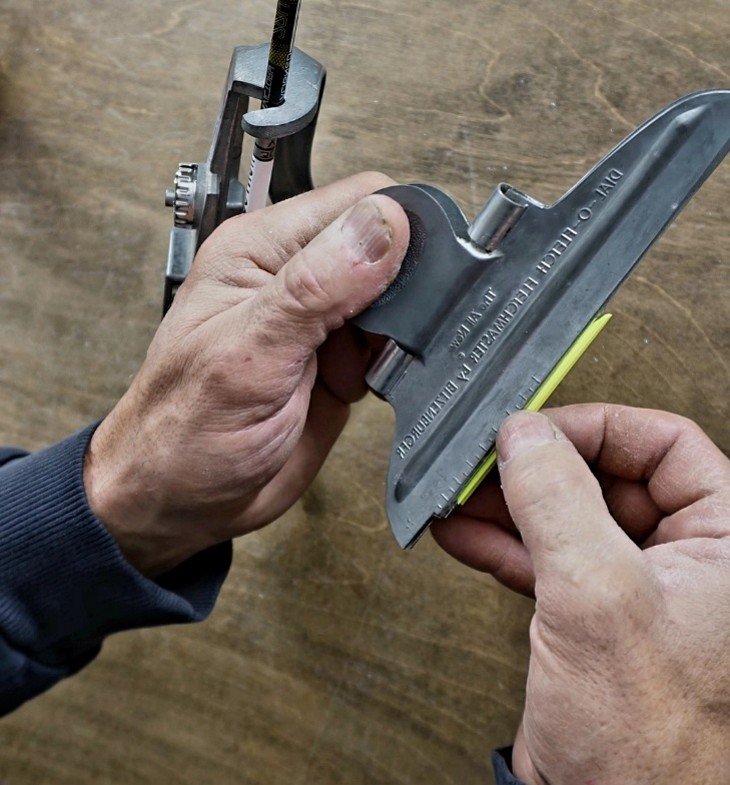
For fletching, I use a clamp and AAE Max Bond glue to lay down that left-offset helical. AAE Hybrid vanes come prepped from the factory, so I never clean the base before gluing. I carefully align each vane on the same reference mark, ensuring all four are positioned identically on every shaft. I leave a tiny gap, about a sixteenth of an inch, between the track and fletching of the vane so the clamp doesn’t ride directly on the vane. I put about five small drops of glue along the base, smooth them out, lower the clamp from the bottom, and hold it for a moment. Each vane gets roughly 30 seconds to set long enough to lock in a good helical, not so long that the clamp risks sticking. Any excess glue gets wiped forward along the vane, which cleans up the joint and reinforces the tip, a common place for helical vanes to start lifting. Max Bond is technically ready in about half an hour, but I always let new arrows sit overnight before I shoot them.
With the back end finished, I move to the front. Cutting carbon leaves dust inside the shaft, so I run a Q-tip soaked in 99 percent alcohol through the interior until it comes out clean. I also wipe down the half-out insert to remove any oils or residue that might weaken the bond. For most hunting builds I use hot melt glue, heating both the insert and the glue with a small torch, then pressing the insert in while lining up the tiny “S” on the half-out with the spine mark on the shaft. Hot melt gives me a major advantage. If I ever need to pull an insert, a soak in hot water will soften the glue. If I want a truly permanent bond, I’ll reach for Loctite 401, but once an insert goes in with that stuff, it’s not coming back out.
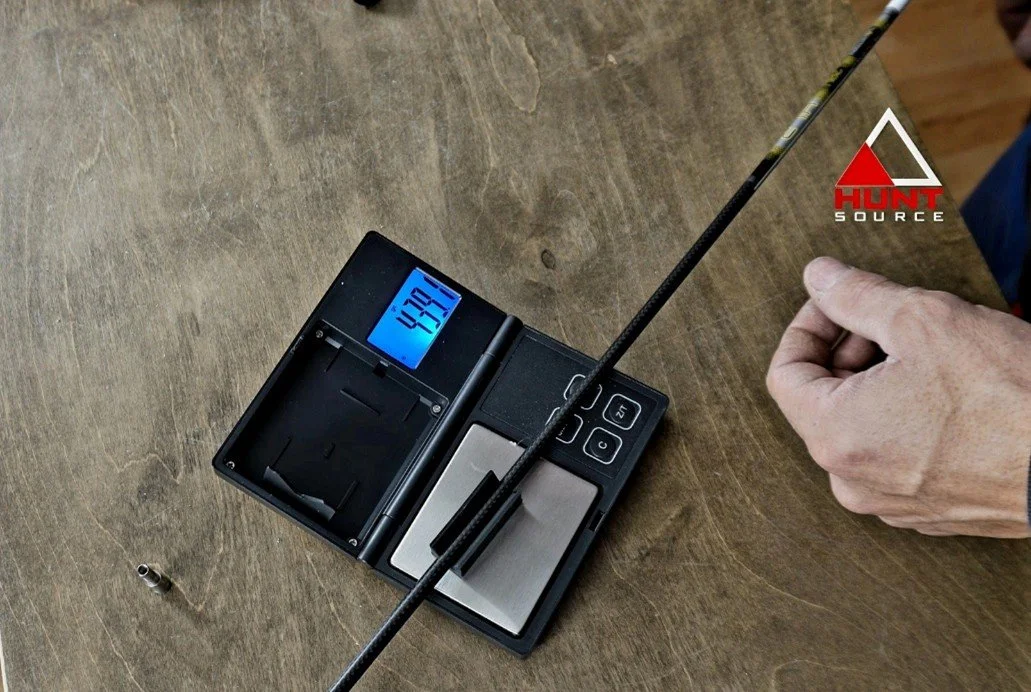
Consistency in total arrow weight is non-negotiable for me. I weigh my finished arrows with both field tips and broadheads installed. Factory “100-grain” components are not always what they claim; I’ve seen field tips down around 92 grains and broadheads well over 100. At longer ranges, that kind of spread can destroy a sight tape. If I see a meaningful difference, I’ll carefully grind a grain or two off the rear of the field point’s threads, checking the scale often, until it matches the broadhead as closely as possible. That way, the tape I build shooting field points still works when the broadheads go on.
I also spend time indexing every arrow. I shoot each shaft through paper, rotate it a quarter turn, and repeat until it shows a consistent tear. Once every arrow in the dozen is tearing the same way—low right, high left, whatever it is—I tune the bow to that tear until I’m getting a clean bullet hole. The result is a bow tuned not to one “golden” arrow, but to an entire batch that all behave the same.
The last step is the chronograph. With my finished arrows landing right at that target 440-grain mark, I’m seeing speeds in the 300 to 310 feet-per-second range out of my Hoyt Lift X, set at a 29-inch draw and 70 pounds. For me, that blend of speed, weight, and careful consistency is exactly what I want: a flat-shooting, reliable hunting arrow built to do its job when it matters most.
